Guest Feedback
Find out about an issue before you see it in a public review
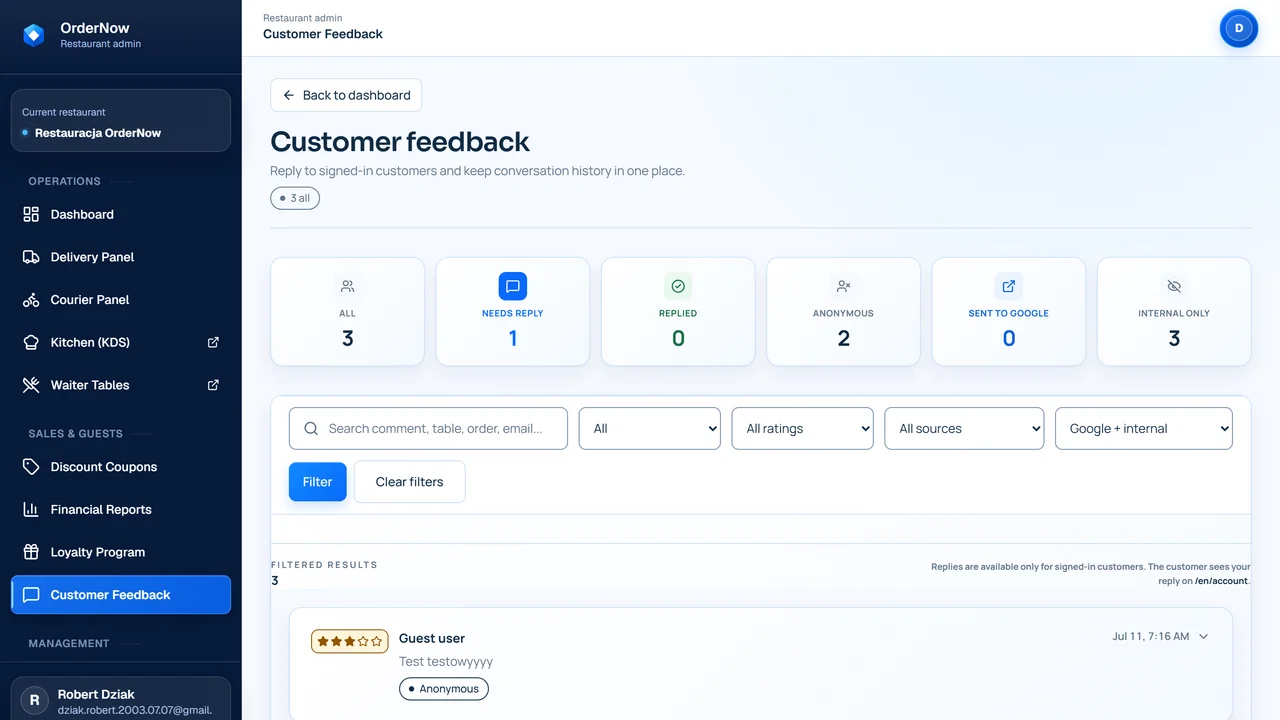
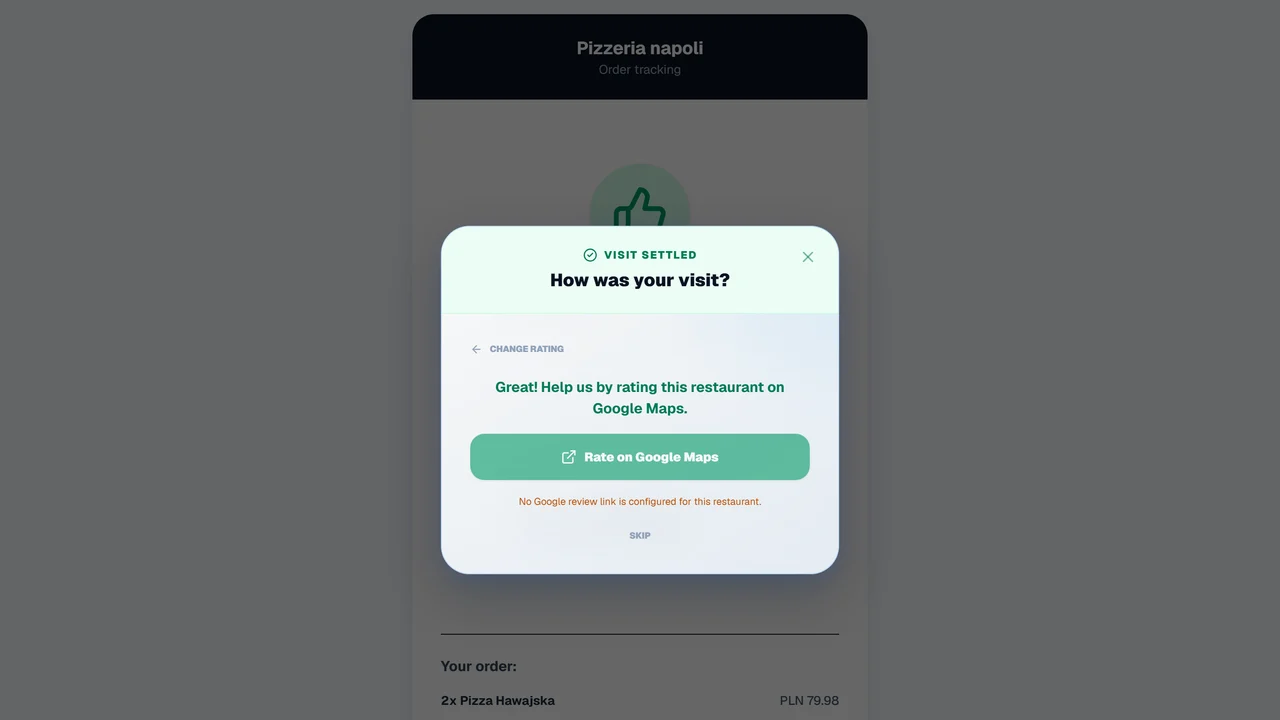
The OrderNow feedback system gives guests a simple way to leave feedback after a visit or order. The manager can spot recurring problems faster, and the guest can get a convenient link to where the restaurant collects public reviews, in accordance with the platform's rules.
After visit
Rating → signal → reaction
Receives a rating request
After a visit or order, the guest can receive a simple request for feedback.
Provides rating and comment
A short rating and comment help indicate whether the issue involves the kitchen, service, delivery, or waiting time.
Forwards feedback to the manager
The information goes to a panel where it can be read and assigned to recurring topics.
What you lose when feedback only appears publicly
Public reviews are important, but they often appear after the fact. Internal feedback helps you spot recurring issues faster.
Manager sees the problem too late
The guest describes the situation publicly, and only then does the venue learn there was an issue with the kitchen, floor, or delivery.
No place for a short comment
Not every guest wants to write a public review. Sometimes they just want to say what went wrong or right.
Problems repeat without a pattern
One review looks like an incident, but several similar signals can reveal a process flaw.
The team lacks a clear reaction loop
Feedback only has value when someone reads it, classifies it, and turns it into a service improvement.
How post-visit or post-order feedback works
This process is not meant to hide criticism or selectively pick happy guests. It's meant to give the restaurant an honest signal and structured reactions.
Receives a rating request
After a visit or order, the guest can receive a simple request for feedback.
Provides rating and comment
A short rating and comment help indicate whether the issue involves the kitchen, service, delivery, or waiting time.
Forwards feedback to the manager
The information goes to a panel where it can be read and assigned to recurring topics.
Can proceed to a public review
A link to a public review should work in line with platform rules, without blocking criticism.
Analyzes recurring issues
The manager can check topics like kitchen, delivery, service, wait times, and order completeness.
Uses signals to improve the process
Feedback makes sense when it leads to a team discussion, process tweak, or operational decision.
Before & After: public review vs structured feedback
Which venues benefit most from a feedback system
It helps most where reviews influence venue choice, and the team has someone responsible for reacting.
- venues with delivery and a high order volume
- restaurants heavily dependent on Google reviews and local reputation
- chains and venues with many shifts
- places wanting to spot operational problems faster
When a feedback system isn't the first priority
Feedback without a reaction just gathers frustration. First, you need to know who reads the signals and what they do with them.
- venues without a process for reacting to feedback
- restaurants lacking a designated person for reviews
- places that only want to filter out negative reviews
- stages where organizing orders and service is more important
What to measure in a feedback system
Don't promise yourself a better rating on Google. Measure whether the restaurant spots issues faster and if the team can react to them.
Number of responses
Shows how many guests actually provide feedback after a visit or order.
Average internal rating
Helps observe quality changes over time, but doesn't replace analyzing specific comments.
Recurring causes of dissatisfaction
Kitchen, delivery, service, and waiting time should be visible as areas for improvement.
Manager response time
Feedback has more value when someone responsible sees it and can make a decision.
Click-throughs to public reviews
You can measure clicks on the public review link, without guaranteeing a rating or position.
How feedback connects with retention, delivery, and reports
An opinion after a visit or order is most valuable when tied to a process that needs improvement.
Loyalty Program
A returning customer can leave feedback, and the restaurant sees the relationship across visits.
Coupons & Discounts
A coupon after an issue only makes sense if it has a clear goal, limit, and cost.
Reports and analytics
Reports help spot recurring topics, ratings, and areas requiring decisions.
Online ordering system
Post-order feedback helps check the quality of your own channel and process completeness.
In-House Delivery
Delivery often affects ratings, so it's good to separate a courier issue from a kitchen issue.
Questions from owners before deploying a feedback system
Does the system filter critical reviews?
Can I send a link to Google reviews?
Does the manager get notified about an issue?
Can reviews be analyzed by orders?
Does the system improve the Google rating?
When does a feedback system make no sense?
Demo with no overpromises
Check how feedback can reach the manager
During the demo, we'll go over post-order ratings, the manager panel, and the public review link—without false promises of review manipulation.