Delivery via your own channel
Got your own couriers? Organize deliveries in one panel
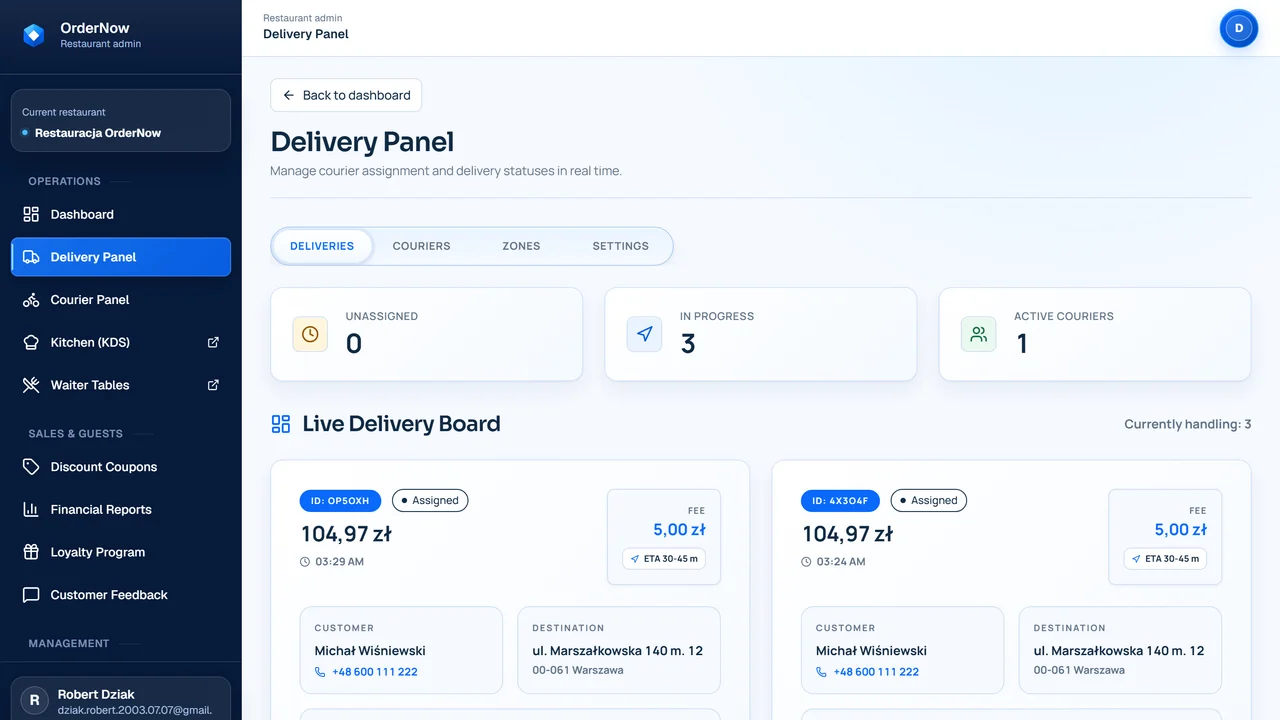
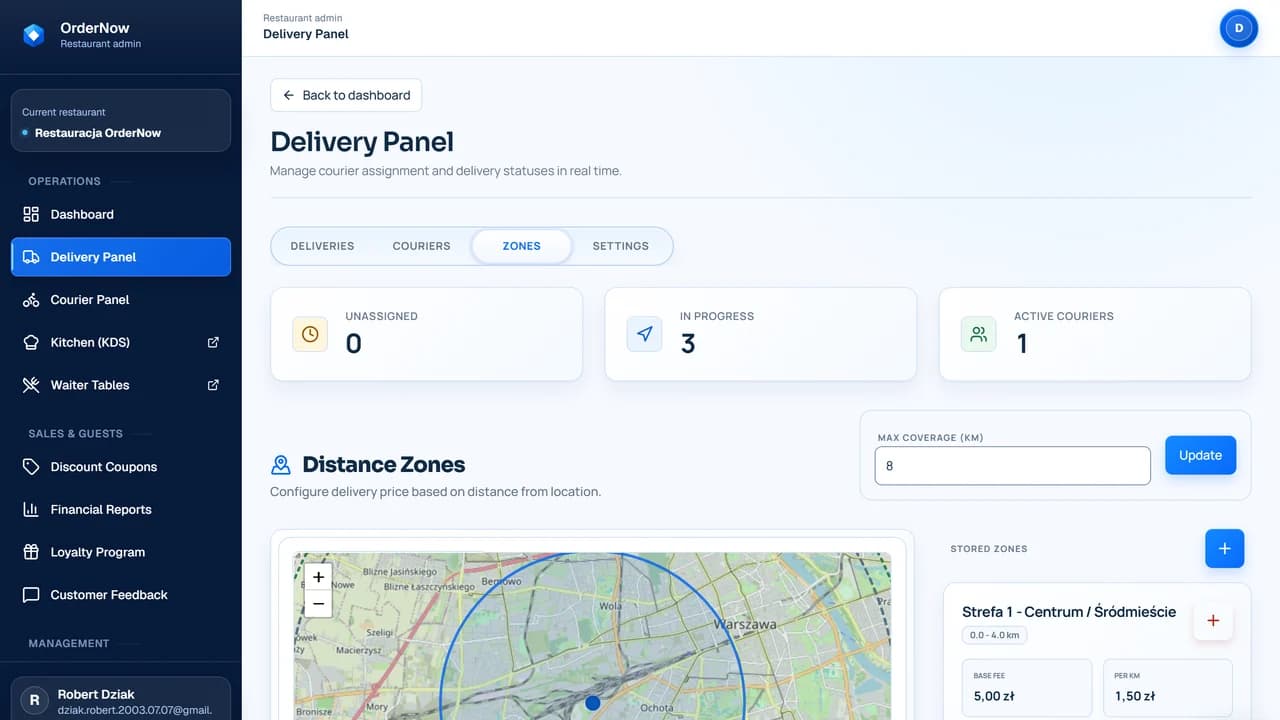
OrderNow's in-house delivery helps manage orders from your own channel: zones, fees, statuses, and courier assignments. This is for venues wanting to grow their own channel alongside marketplaces, but without running deliveries on paper, phones, and team memory.
Delivery process
Address → zone → courier
Places an order in your channel
The order goes straight to the restaurant with address, contact info, and chosen fulfillment method.
Checks zone, cost, and minimum
The address is checked against the set delivery zone, fee, and minimum order value.
Prepares the order for dispatch
The team sees it's a delivery and can work according to the packing and dispatch process.
What ruins in-house deliveries without a process
In-house delivery isn't free and isn't always cheaper than a marketplace. It only makes sense when the venue controls the area, people, cost, and statuses.
Addresses and statuses are handled manually
Staff types data into a phone or writes it on paper, and the kitchen and couriers don't see the same version of the order.
Delivery zones are too wide
The venue takes orders from an area that looks good on a map, but doesn't make sense in terms of time and driving cost.
In-house handling cost isn't calculated
Courier, fuel, packaging, payments, labor, and marketing remain the restaurant's responsibility.
Marketplace and own channel are mixed up
In-house deliveries can work alongside portals, but they require separate tracking for cost and service quality.
How an order goes through in-house delivery
A good delivery process starts with checking the address and cost, and ends with order status and data to compare against marketplaces.
Places an order in your channel
The order goes straight to the restaurant with address, contact info, and chosen fulfillment method.
Checks zone, cost, and minimum
The address is checked against the set delivery zone, fee, and minimum order value.
Prepares the order for dispatch
The team sees it's a delivery and can work according to the packing and dispatch process.
Assigns delivery to courier
The task can be assigned to the driver without searching for the address in multiple places.
Sees delivery status
Statuses help distinguish prep, pick-up, en-route, and delivery completion.
Compares own cost with marketplace
Data shows how many orders go through your own channel and what the remaining cost is for the venue.
Before & After: calling the courier vs delivery panel
Which venues benefit most from in-house delivery
It works best where the venue has its own drivers, a fixed delivery area, and repeatable local demand.
- pizzerias, sushi, kebabs, burgers, and venues with frequent deliveries
- restaurants with their own drivers or dedicated delivery staff
- venues with traffic from Google, Facebook, or Instagram
- places with repeatable orders in a close-by area
When in-house delivery isn't the first priority
Your own delivery channel needs people and a process. Without them, it's better to organize online ordering first or stick to marketplaces.
- venues without their own couriers
- restaurants lacking a process for packing and dispatching orders
- a highly scattered delivery area
- venues without their own ordering channel
- places where marketplace is still the main source of demand
What to measure with in-house delivery
Don't assume in-house delivery always saves money. Compare marketplace commission with the full handling cost on the restaurant's side.
Number of orders in own channel
Shows if the restaurant has enough traffic outside marketplaces to make a delivery process viable.
Average delivery cost
Calculate courier, fuel, packaging, payments, operations, and marketing for your own channel.
Courier cost and fulfillment time
Check if the delivery area overloads the team and hurts service quality.
Value of orders outside marketplace
Separate commission-free orders in your own channel from portal orders.
Customer returns from own channel
Measure whether the customer returns directly to the restaurant, not just via the middleman app.
How in-house delivery connects with the rest of the system
Delivery is part of a process spanning from online order, through the kitchen, to reports and customer retention.
Online ordering system
This is the source of orders in your own channel, which can handle pick-up or in-house delivery.
KDS
The kitchen sees the order queue and can distinguish deliveries from dine-in orders.
Reports and analytics
Reports help compare your own channel, delivery costs, and marketplace orders.
Coupons & Discounts
Coupons can support your own channel if they have limits, conditions, and calculated promo costs.
Loyalty program
A returning customer from your own channel can collect points and order again without a middleman.
Questions from owners before launching in-house delivery
Do I need my own couriers?
Does in-house delivery replace marketplace?
Can I set zones and minimum order values?
How do I compare in-house delivery cost with portal commission?
Do deliveries connect with online orders?
When does in-house delivery make no sense?
Demo with no overpromises
Let's calculate if in-house delivery works for your venue
During the demo, we'll walk through the online channel, zones, courier cost, packaging, and statuses to check if in-house delivery is a good step.